Alternatives
Purpose
Generate a range of options for addressing the decision ethically.
Key Concepts
Ethical decision-making requires creativity. There is rarely only one path forward. This step invites you to develop multiple alternatives that aim to meet the business objective while reducing harm and aligning with values.
Do not limit yourself to either/or thinking. Some of the best ethical solutions arise from compromise, hybrid models, or entirely new approaches.
In Practice
Example Scenario
Instead of fully replacing the rural call centre with AI, NexaTech could:
- Hybrid model: Use AI for first-tier customer inquiries while retaining a smaller staff for complex cases.
- Phased transition: Introduce AI gradually with retraining options for staff.
- Community partnership: Collaborate with local government to support job placement or entrepreneurship.
- Full closure: Proceed with the layoffs, offering generous severance and public accountability.
These alternatives show that cost-saving and community responsibility are not necessarily opposites.
Tips and Tools
- Use brainstorming techniques.
- Encourage wild ideas, then assess feasibility.
- Avoid “false dilemmas” that limit thinking to two extremes.
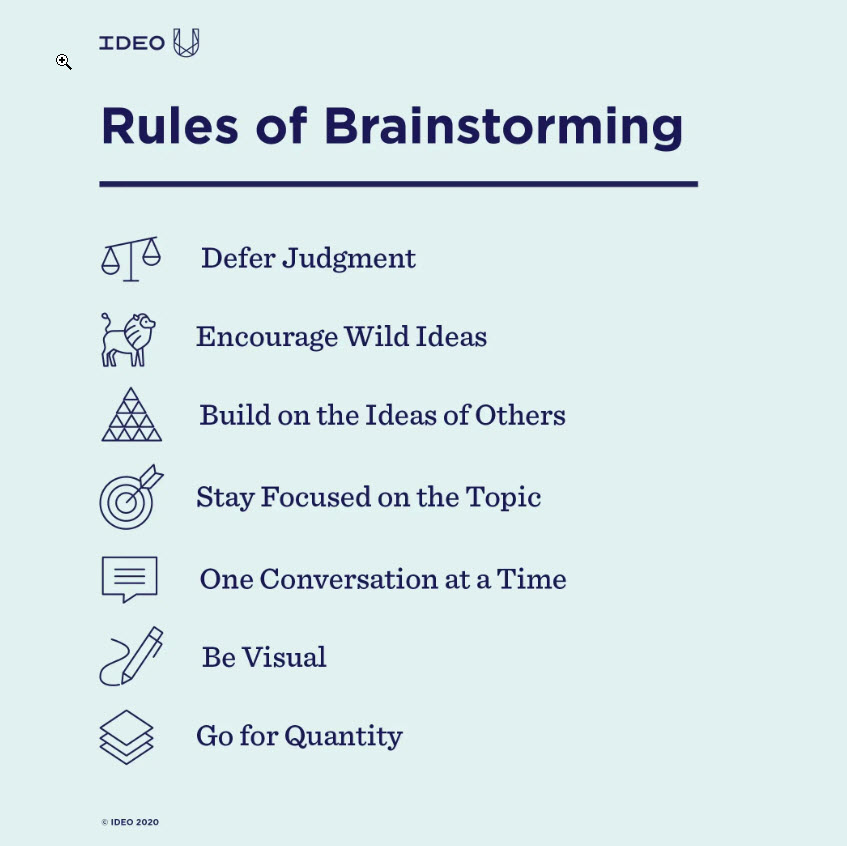
7 Simple Rules of Brainstorming
Brainstorming helps teams move past obvious answers and spark breakthrough ideas. To make it effective, follow these seven rules:
- Defer judgment: Hold back criticism so ideas can flow freely.
- Encourage wild ideas: Bold or “out there” ideas often lead to the best solutions.
- Build on others’ ideas: Use “yes, and…” to expand possibilities.
- Stay focused: Keep the discussion tied to the challenge at hand.
- One conversation at a time: Listen and let each voice be heard.
- Be visual: Use Post-its, sketches, or diagrams to share ideas clearly.
- Go for quantity: Aim for lots of ideas; the more you have, the more likely a great one will emerge.
Tip: A safe, inclusive space where everyone contributes is key to successful brainstorming.
Reference: IDEO U. (2025, March 28). 7 simple rules of brainstorming for better ideas & stronger collaboration. https://www.ideou.com/blogs/inspiration/7-simple-rules-of-brainstorming?srsltid=AfmBOoqhzhTslIob6FuxXlYaVk-sbMOu4oExFxYYelmuWg-Z4JUxvIHC
Next Step
With multiple alternatives in hand, it is time to assess which one aligns best with ethical principles and stakeholder needs.
When you’re ready, continue to the next part of the process:
Proceed to: Assessment of Alternatives →
A false dilemma in ethical decision-making is a situation where only two options are presented as the only possibilities, when in reality, other options or a middle ground exist. This fallacy limits the scope of available choices, potentially leading to a flawed or biased decision. It's also known as a false dichotomy, false binary, or either/or fallacy.
