
Monitor and Feedback
Purpose
Assess the outcome of your decision, gather feedback, and reflect on ethical performance.
Key Concepts
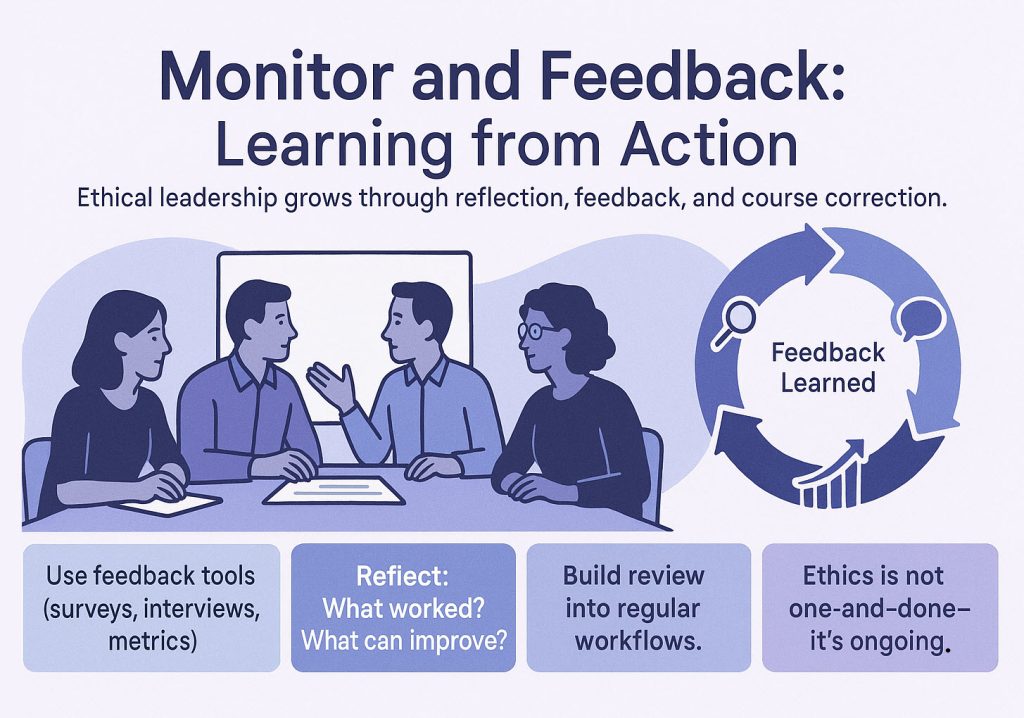
Ethical decision-making is an ongoing process. Monitoring outcomes ensures your decision is working as intended and helps identify any unintended consequences. Feedback allows you to course-correct, improve transparency, and build a learning culture.
Reflection is not a bonus step; it is how ethical leadership grows.
In Practice
Example Scenario
Three months after the hybrid rollout, NexaTech surveys customers, checks in with impacted employees, and hosts a community town hall. Feedback shows improved customer satisfaction and gratitude from staff for the support. One gap emerges: a small team feels left out of retraining. NexaTech adjusts the plan and commits to more inclusive communication next time.
Tips and Tools
- Use surveys, interviews, and metrics to gather feedback.
- Build reflection into your team’s workflow (e.g., post-decision review meetings).
- Ask: What worked? What could be done differently? What did we learn?
Wrapping Up!
You have now completed the ethical decision-making cycle, from defining the issue to reflecting on its outcome. With practice, this model becomes more than a process. It becomes part of how you lead.
