
4 Contemporary Psychology and Neuroscience
written by Jennifer Stamp & Kevin LeBlanc
Learning Objectives
By the end of this section, you will be able to:
- Appreciate the diversity of interests and foci within psychology and neuroscience
- Understand basic interests and applications in each of the described areas of psychology and neuroscience
- Demonstrate familiarity with some of the major concepts or important figures in each of the described areas of psychology and neuroscience
This section provides an overview of the major subdivisions within psychology and neuroscience today. This list isn’t exhaustive, but it provides insights into the major areas of research and application.
Cellular Neuroscience
Cellular neuroscience is the study of how individual cells in the nervous system contribute to brain function and behaviour. The primary focus of cellular neuroscientists is the neuron, the specialized cell responsible for communicating information throughout the nervous system. Researchers in this area examine how neurons develop, how they communicate with one another through electrical and chemical signals, and how these processes are influenced by genes, experience, and the environment. For example, cellular neuroscientists may study how changes in neurotransmitter systems affect mood, learning, or movement, or how disruptions in cellular processes contribute to neurological disorders. Although cellular neuroscience focuses on events occurring on a very small scale, understanding how individual neurons function provides the foundation for understanding how larger networks of neurons produce complex behaviours.

Figure IP.4 Drawing of a cerebellar Purkinje cell by Santiago Ramon y Cajal, who is credited with the theory that neurons are separate cells that make up the nervous system (Image credit: Wikimedia Commons)
Behavioural Neuroscience
Behavioural neuroscience is a field of study that focuses on the biological basis of thought, emotion, and behaviour. This broad field usually involves manipulation of the brain, spinal cord, or nerves to assess the effect on a specific outcome. Brain manipulations can be invasive, so non-human animals are commonly used although the intent is often to model human conditions. In the 1940s, two German scientists at the University of Tübigen, Hans Peters and Peter Witt collaborated on an unusual project using LSD and other drugs. Peters was a zoologist studying web-building in spiders and he faced an HR problem. Spiders typically spin webs between 2AM and 5AM and this conflicted with his research team’s work schedule. He asked his friend Peter Witt, a pharmacologist, if drugs could be used to shift the spiders’ activity to a more convenient time, earlier in the day. They initially tried stimulants like caffeine and amphetamine, which had no effect at all on the spiders’ schedule. However, the webs they did build looked like plates of spaghetti (Witt, 1954). Other drugs, like high doses of the hallucinogen psilocybin (from magic mushrooms), stopped web-building for several days (Witt, 1960). Although its effect on neurons is similar to psilocybin, LSD (acid) administration resulted in excellent webs, more detailed and precise than those made by untreated spiders.
Witt abandoned his research on humans and spent the rest of his career testing the effects of different drugs on spiders (Witt, 1971). These “drug webs” caught the interest of others who saw potential to detect drugs in body fluids from human users. In 1995, NASA published results of their own drug web research as a way to measure toxicity (Noever et al., 1995) (Figure IP.5). Note that the webs built under the influence of caffeine and benzadrine (also known as amphetamine) were messed up. Moderate doses of these types of stimulants usually enhance attention and motor performance in humans, while hallucinogens like LSD and psilocybin profoundly alter perception.
 Figure IP.5 Webs of house spiders after administration of different classes of drugs: marijuana, the stimulants benzadrine and caffeine, and the anaesthetic chloral hydrate. Image source: Noever et al., (1995).
While such studies may appear strange at first glance, they highlight one of the major purposes of behavioural neuroscience: the use of changes in behaviour in understanding how the nervous system functions. Scientists might temporarily alter the functioning of a certain part of the brain of the animal and see how its behavior is changed in terms of memory, movement or decision making to understand what this part of the brain does. By manipulating biological systems and observing their effects on behaviour, researchers can gain insight into the neural mechanisms underlying perception, cognition, emotion, and action.
Evolutionary Psychology
While behavioural neuroscience typically focuses on the immediate biological causes of behaviour, evolutionary psychology seeks to study the ultimate causes of behaviour over generations. Like anatomical characteristics, behaviours adapt to changes in physical and social surroundings to promote survival of individuals and their offspring, referred to as natural selection. Charles Darwin is credited with developing the theory of evolution through natural selection after his famous journey aboard the HMS Beagle from 1831-1836. After comparing the physical and behavioural traits of different species across the world, Darwin published his influential On the Origin of Species (1859) which suggested that the diversity of life on earth derived from a common ancestor. He later extended his ideas in The Descent of Man (1871) and The Expression of the Emotions in Man and Animals (1872). Evolutionary psychology has, at its core, a focus on inherited traits.
The approach taken by most evolutionary psychologists who study human participants is to predict the outcome of a behaviour in a particular situation based on evolutionary theory and then to make observations, or conduct experiments, to determine whether the results match the theory. It is important to recognize that these types of studies are not strong evidence that a behaviour is adaptive, since they lack information that the behaviour is in some part genetic and not entirely cultural (Endler, 1986). Demonstrating that a trait, especially in humans, is naturally selected is very difficult; perhaps for this reason, some evolutionary psychologists are content to assume the behaviours they study have genetic determinants (Confer et al., 2010).
Sensation & Perception
Scientists interested in how sensory systems detect and process information, as well as how we psychologically experience that information, work within the area of sensation and perception. Sensation involves detecting information from the environment through our sensory systems, whereas perception involves interpreting and organizing that information to create meaningful experiences. As such, sensation and perception research is highly interdisciplinary, drawing on psychology, neuroscience, biology, and other fields to understand how we detect, interpret, and make sense of information from the world around us. Researchers in this area investigate questions such as how we see colour and motion, recognize objects and faces, locate sounds, experience touch and pain, perceive smells and tastes, and maintain our sense of balance and body position. Imagine walking between buildings as you move from one class to another. You are inundated with sights, sounds, touch sensations, and smells. You also experience the temperature of the air around you and maintain your balance as you make your way. These everyday experiences provide examples of the kinds of sensory and perceptual processes that researchers study.
As described in a later chapter that focuses on the results of studies in sensation and perception, our experience of our world is not as simple as the sum total of all sensory information (or sensations) together. Rather, our experience (or perception) is complex and is influenced by where we focus our attention (Fig IP.6), our previous experiences, and even our cultural backgrounds.
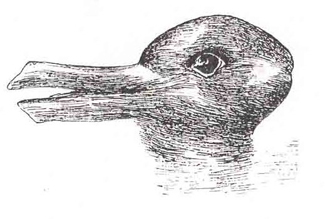
Figure IP.6 When you look at this image, you may see a duck or a rabbit. The sensory information remains the same, but your perception can vary dramatically.
Cognitive Neuroscience
Cognitive neuroscience is the study of the relationship between brain activity and cognitive processes, such as perception, attention, memory, language, decision-making, and problem solving. This field emerged from the integration of neuroscience and cognitive psychology, combining methods for studying brain function with theories about how the mind processes information. Cognitive neuroscientists use a variety of techniques, including brain imaging, electrophysiology, and studies of individuals with brain injuries, to investigate how different brain regions and networks contribute to cognition. For example, researchers may investigate how the two hemispheres of the brain contribute differently to functions such as language and spatial processing, or how communication between brain regions allows us to recognize objects and understand language. By linking patterns of brain activity with specific cognitive abilities, cognitive neuroscience helps explain how biological processes give rise to complex human thought and behaviour.
Cognitive Psychology
Whereas cognitive neuroscience focuses on the biological mechanisms that support cognition, cognitive psychology focuses on understanding the mental processes involved in thinking and how these processes influence behaviour. Its focus is studying cognitions, or thoughts, and their relationship to our experiences and our actions and its broad scope often involves collaborations among people from a diverse range of disciplinary backgrounds. This has led some to coin the term cognitive science to describe the interdisciplinary nature of this area of research (Miller, 2003).
Cognitive psychologists have research interests that span a spectrum of topics, ranging from attention (Figure IP.7) to problem solving to language to memory. The approaches used in studying these topics are equally diverse. Given such diversity, cognitive psychology is not captured in one chapter of this text per se; rather, various concepts related to it will be covered in relevant portions of the chapters in this text on sensation and perception, thinking and intelligence, memory, lifespan development, social psychology, and therapy.

Figure IP.7 Can you spot the differences? The study of attentional processes by cognitive psychologists have broad applications to distracted driving, eyewitness testimony, and advertising. (Image credit: Wikimedia Commons)
Developmental Psychology
Developmental psychology is the scientific study of changes in physical, cognitive, social, and emotional capabilities over the lifespan. Developmental psychologists are interested in processes related to physical maturation, cognitive skills, moral reasoning, social behaviour, and other psychological attributes.
Early developmental psychologists focused primarily on changes from birth through reaching adulthood, providing insight into the differences between very young children and adults. Research by Jean Piaget demonstrated that very young children do not demonstrate object permanence, the understanding that physical things continue to exist, even when hidden from view. If you show an adult a toy, and then hide it behind a curtain, the adult knows that the toy still exists. However, very young infants act as if a hidden object disappeared, which makes peek-a-boo so much fun (Figure IP.8). The age at which object permanence is achieved is somewhat controversial but becomes gradually established during a child’s first year (Munakata, McClelland, Johnson, and Siegler, 1997).

Figure IP.8 Peek-a-boo and the development of object permanence (Image credit: Wikimedia Commons)
While Piaget was focused on cognitive changes during infancy and childhood as we move to adulthood, there is an increasing interest in extending research into the changes that occur much later in life. This may be reflective of changing global population. As more people live longer lives, the number of people of advanced age will continue to increase. In 2010, there were almost 5 million Canadians aged 65 or older, increasing to 7 million in 2020. Population projections predict that Canada could have 10 – 12 million adults aged 65 and over by 2050, reflecting the aging of the baby-boom generation and increasing life expectancy (Statistics Canada, 2025).
Personality Psychology
Personality psychology focuses on patterns of behaviour that make us different than other people. Modern research in personality psychology takes a quantitative approach by focusing on identifying personality traits, measuring them, and determining how they interact in a particular context to determine how a person will behave in any given situation. Personality traits are relatively consistent patterns of thought and behaviour, and many have proposed that five trait dimensions are sufficient to capture the variations in personality seen across individuals. These five dimensions are known as the “Big Five” or the Five Factor model, and include dimensions of conscientiousness, agreeableness, neuroticism, openness, and extraversion (Figure IP.9). Each of these traits has been demonstrated to be relatively stable over the lifespan (e.g., Rantanen, Metsäpelto, Feldt, Pulkinnen, and Kokko, 2007; Soldz & Vaillant, 1999; McCrae & Costa, 2008) and is influenced by genetics (e.g., Jang, Livesly, and Vernon, 1996).
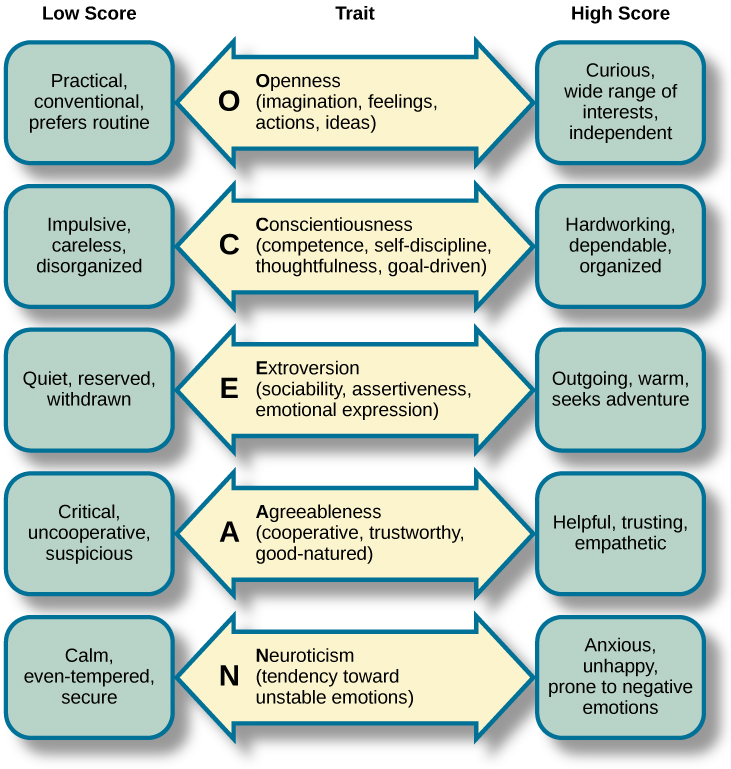
Figure IP.9 Each of the dimensions of the Five Factor model is shown in this figure. The provided description would describe someone who scored highly on that given dimension. Someone with a lower score on a given dimension could be described in opposite terms.
Social Psychology
There are many interesting examples of social psychological research, and you will read about many of these in a later chapter of this textbook. One of the most controversial was conducted by Stanley Milgram, an American social psychologist most famous for research that he conducted on obedience, motivated by the horrific behaviour of Nazi soldiers during the Holocaust. How were German people capable of torturing prisoners in concentration camps? Were they simply following orders? Milgram decided to conduct research to determine the extent to which ordinarily people would obey orders to commit terrible acts, under carefully controlled laboratory conditions (Figure IP.10).
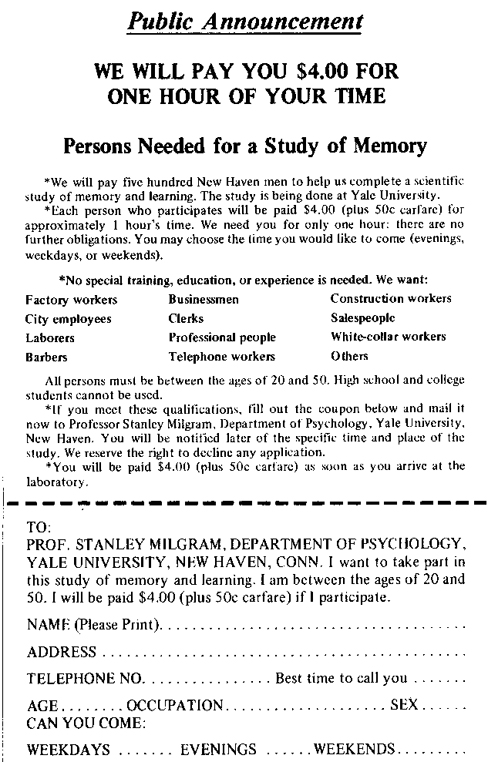
Figure IP.10 Stanley Milgram’s research demonstrated just how far people will go in obeying orders from an authority figure. This advertisement was used to recruit subjects for his research.
As you will read later in the text, Milgram found that nearly two-thirds of his participants were willing to deliver what they believed to be lethal shocks to another person, simply because they were instructed to do so by an authority figure wearing a lab coat. This was despite of the fact that participants received payment for simply showing up for the research study and could have chosen not to inflict pain or more serious consequences on another person by withdrawing from the study (Milgram, 1963). No one was actually hurt or harmed in any way, Milgram’s experiment was a clever ruse that took advantage of research confederates, those who pretend to be participants in a research study who are actually working for the researcher and have clear, specific directions on how to behave during the research study (Hock, 2009). Milgram’s and others’ studies that involved deception and potential emotional harm to study participants catalyzed the development of ethical guidelines for conducting psychological research that discourage the use of deception of research subjects, unless it can be argued not to cause harm and, in general, requiring informed consent of participants.
Industrial-Organizational Psychology
Industrial-Organizational psychology (I-O psychology) is a subfield of psychology that applies psychological theories to human behavior in the workplace with the aim of improving both employee well-being and organizational performance. I-O psychologists are often involved in issues related to personnel management, organizational structure, and workplace environment. Businesses often seek the aid of I-O psychologists to make the best hiring decisions as well as to create an environment that results in high levels of employee productivity and efficiency. For example, an I-O psychologist might help a company develop a fair and effective interview process for selecting new employees or evaluate ways to reduce workplace stress and improve employee satisfaction. In addition to its applied nature, I-O psychology also involves conducting scientific research on behaviour within I-O settings (Riggio, 2013).
Health Psychology
Health psychology focuses on how health is affected by the interaction of biological, psychological, and sociocultural factors. This approach is known as the biopsychosocial model. Health psychologists are interested in helping individuals achieve better health through public policy, education, intervention, and research (Fig IP.11). Health psychologists might conduct research that explores the relationship between one’s genetic makeup, patterns of behaviour, relationships, psychological stress, and health. They may research effective ways to motivate people to address patterns of behaviour that contribute to poorer health (MacDonald, 2013).

Sport Psychology
Researchers in sport psychology study the psychological aspects of sport performance, including motivation and performance anxiety, and the effects of sport on mental and emotional wellbeing. For example, sport psychologists may study how mental imagery can be used to improve performance. Athletes can mentally rehearse a skill or performance by imagining themselves executing the movements successfully, such as a gymnast visualizing a routine or a basketball player imagining making a free throw. Research is also conducted on similar topics related to physical exercise in general. The discipline also includes topics that are broader than sport and exercise but that are related to interactions between mental and physical performance under demanding conditions, such as fire–fighting, military operations, artistic performance, and surgery.
Clinical Psychology
Clinical psychology focuses on the diagnosis and treatment of psychological disorders and other problematic patterns of behaviour. As such, it is generally considered to be a more applied area within psychology; however, some clinicians are also actively engaged in scientific research. Counselling psychology is a similar discipline that focuses on emotional, social, vocational, and health-related outcomes in individuals who are considered psychologically healthy.
Theorists like Sigmund Freud and Carl Rogers provided perspectives that have been influential in shaping how clinicians interact with people seeking psychotherapy. Roger’s ideas about client-centred therapy have been especially influential in shaping how many clinicians operate. Issues related to the diagnosis and treatment of psychological disorders and problematic patterns of behaviour will be discussed in detail in later chapters of this textbook.
Neuropsychology
Neuropsychology focuses on understanding the role of the brain in cognition, particularly how brain injury or neurological illness affects thinking and behaviour. Neuropsychologists often study individuals who have experienced damage to specific areas of the brain to better understand how different brain systems contribute to cognitive abilities such as memory, language, attention, and decision-making. This area of psychology shares some similarities with clinical psychology, as neuropsychologists often work in applied settings to assess and support individuals experiencing cognitive changes. For example, a clinical neuropsychologist may work in rehabilitation following a stroke or traumatic brain injury, helping individuals understand and manage changes in their cognitive abilities.
Forensic Psychology
Forensic psychology is a branch of psychology that asks questions related to the justice system. Some forensic psychologists study what makes people break social norms to cause violence, like murder. Others study eyewitness testimony, such as how question wording about a crime can influence the type of answer given. This applied field of study borrows concepts from other sub-fields, like social and cognitive psychology.
