
15 Standards of Professional Practice
REQUIRED READING
These Standards of Professional Practice are in place to ensure that NSCC student leaders follow set standards for conduct, helping to increase the professionalism of Student Association practices.
Conflict of Interest
These instances may arise, and are only considered acceptable if the final decision is objective and informed and benefits the Student Association as a whole.
Examples
- Providing services to an external organization
- Recommending a friend or relative for a position
Conflict of Commitment
Conflicts of commitment are not considered illegal, however the risks and impact of the conflict may include public/campus misunderstanding and may lead to a loss of confidence or damage to the Student Association’s reputation.
Examples
- Serving as an Executive as well as a Society Chairperson
- Serving as an Executive of both the Student Association and Enactus
Policy on Conflict of Interest & Conflict of Commitment
Student leaders are required to disclose any potential or perceived conflicts of interest or conflict of commitment.
You should not participate in decisions or processes where a conflict of interest exists, and must declare the conflict and remove yourself from activities related to the conflict of interest.
You should not engage in conflicting activities unless approved by the Students’ Council. If approved, you should follow all terms and conditions set by Council at the time of approval.
Code of Ethics
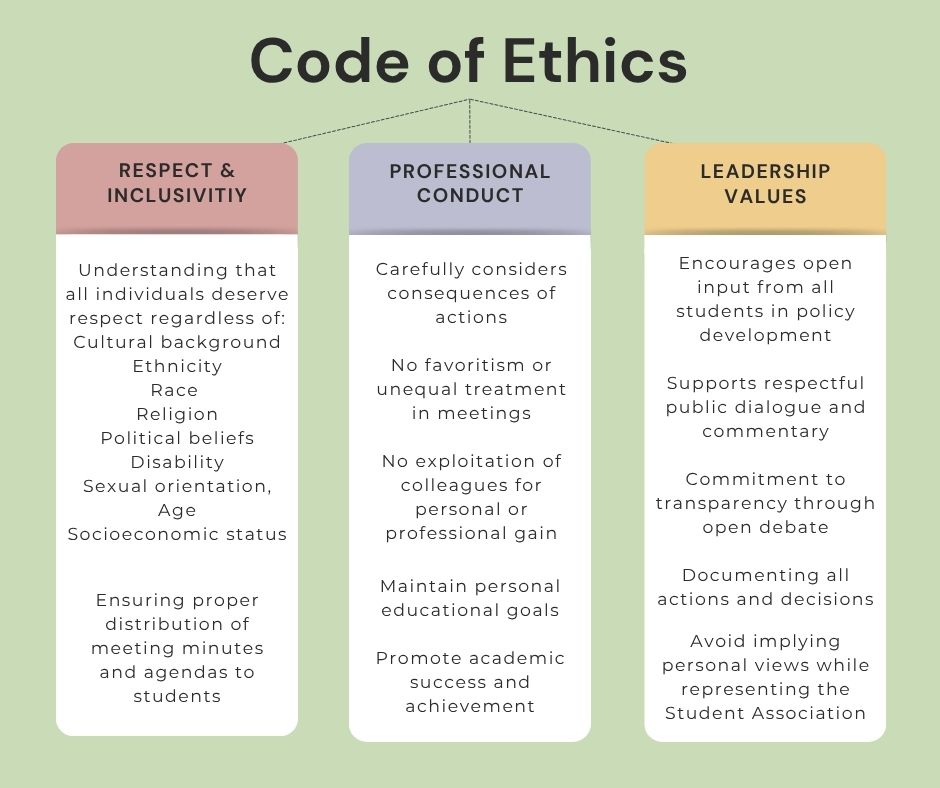
The Code of Ethics is in place to ensure that all individuals act with moral integrity through a system of moral principles around respect and inclusivity and professional conduct. This also includes student leadership values in delivering the mission of the Student Association.
- Respect & inclusivity: Understanding that all individuals deserve respect regardless of cultural background, ethnicity, race, religion, political beliefs, disability, sexual orientation, age, or socioeconomic status.
Ensuring proper distribution of meeting minutes and agendas to students. - Professional conduct: Carefully considers consequences of actions with no favouritism or unequal treatment in meetings, no exploitation of colleagues for personal or professional gain. The maintenance of personal educational goals along with the promotion of academic success and achievement.
- Leadership Values: Encourages open input from all students in policy development; supports respectful public dialogue and commentary; demonstrates a commitment to transparency through open debate; documenting all actions and decisions; avoid implying personal views while representing the Student Association.
A conflict of interest arises when your personal/professional interests may conflict with the best interests of the Student Association.
a specific kind of conflict of interest involving divided attention or effort. This can occur when an officer is committed to both the Student Association as well as another organization or activity that could interfere.