
Book Title: Introduction to Psychology
Subtitle: 1st Canadian Edition
Download this book
Book Description: See also: Introduction to Psychology Student Study Guide
This book is designed to help students organize their thinking about psychology at a conceptual level. The focus on behaviour and empiricism has produced a text that is better organized, has fewer chapters, and is somewhat shorter than many of the leading books. The beginning of each section includes learning objectives; throughout the body of each section are key terms in bold followed by their definitions in italics; key takeaways, and exercises and critical thinking activities end each section.
Contents
Book Information
Book Description
This book is designed to help students organize their thinking about psychology at a conceptual level. The focus on behaviour and empiricism has produced a text that is better organized, has fewer chapters, and is somewhat shorter than many of the leading books. The beginning of each section includes learning objectives; throughout the body of each section are key terms in bold followed by their definitions in italics; key takeaways, and exercises and critical thinking activities end each section.
To facilitate learning outcomes, three techniques have been used:
- Chapter openers.The focus on behaviour begins each chapter with an opener showcasing an interesting real-world example of people who are dealing with behavioural questions and who can use psychology to help them answer those questions. The opener is designed to draw the student into the chapter and create an interest in learning about the topic.
- Psychology in everyday life.Each chapter contains one or two features designed to link the principles from the chapter to real-world applications in business, environment, health, law, learning, and other relevant domains. For instance, the application in Chapter 7 “Growing and Developing” — “What Makes a Good Parent?” — applies the concepts of parenting styles in a mini handbook about parenting, and the application in Chapter 4, “Brains, Bodies, and Behaviour,” is about the difficulties that left-handed people face performing everyday tasks in a right-handed world.
- Research focus.Empiricism is also emphasized throughout, but without making it a distraction from the main story line. Each chapter presents one or more close-ups on research — well-articulated and specific examples of research within the content area, each including a summary of the hypotheses, methods, results, and interpretations. This feature provides a continuous thread that reminds students of the importance of empirical research. The research foci also emphasize the fact that findings are not always predictable ahead of time (dispelling the myth of hindsight bias) and help students understand how research really works.
In short, the authors have attempted to bring psychology to life in ways that really matter to students while, at the same time, maintaining content and conceptual rigor, with a strong focus on the fundamental principles of empiricism and the scientific method.
Book Source
This book is a cloned version of Introduction to Psychology - 1st Canadian Edition by Charles Stangor and Jennifer Walinga, published using Pressbooks by BCcampus under a CC BY-NC-SA (Attribution NonCommercial ShareAlike) license. It may differ from the original.
License

Introduction to Psychology Copyright © 2014 by Jennifer Walinga and Charles Stangor is licensed under a Creative Commons Attribution-NonCommercial-ShareAlike 4.0 International License, except where otherwise noted.
Subject
Psychology
Metadata
-
Introduction to Psychology Copyright © 2014 by Jennifer Walinga and Charles Stangor is licensed under a Creative Commons Attribution-NonCommercial-ShareAlike 4.0 International License, except where otherwise noted.
This book is an adaptation of Introduction to Psychology © 2010 by Charles Stangor, which is under a CC BY-NC-SA 3.0 Licence. This adaptation includes the following changes and additions which are © 2014 by Jennifer Walinga and are licensed under a CC BY-NC-SA 4.0 Licence. See the version history chapter for changes and revisions.
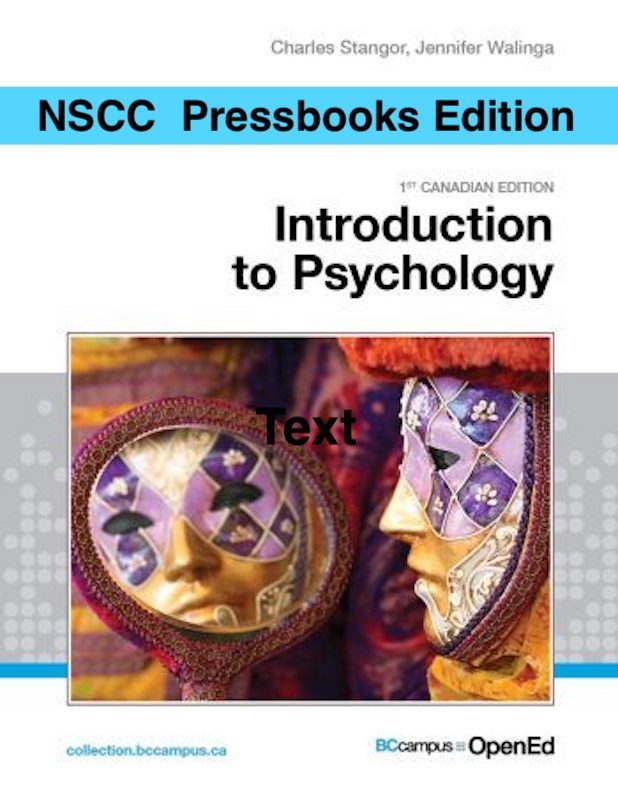
Cover image attribution: Another hand mirror reflection by Frank Kovalchek is used under a CC BY 2.0 Licence.